Turtle Nesting Season
Sea Turtle Nesting Season – April 15th – October 15th in the Florida Keys
Posted: August 01, 2022 by Key Colony Beach Realty
If you walk along Florida beaches at night from May to October, you might be able to witness the magical event of a sea turtle nesting. In fact, 90 percent of all sea turtle nesting in the United States occurs on Florida’s beaches. And mothers return to the beach where they hatched to lay their own nests.
Five out of the seven species of sea turtles can be found in Florida waters: hawksbill, Kemp’s ridley, loggerhead, leatherback, and green sea turtles. In the year 2021 there was an estimated 131,000 turtle nests laid during nesting season. Out of that almost 600 nests were laid here in the Keys. These turtles mate in the coastal waters offshore, and then the females crawl onto the beach to lay their eggs. Under the guide of night, the female hauls herself up the beach until she finds the perfect setting to dig her nest, preferably someplace quiet and dark.
First, the female digs a body pit using all four flippers and then uses her rear flippers to dig an egg chamber as deep as her flippers can reach. Then a quick succession of one to four glistening white ping-pong-shaped eggs plopping into her nest at a time. This process of contractions and laying eggs is repeated until the female is finished. The clutch, which is the number of eggs the sea turtle lays, is usually between 80-120 eggs, although it varies by species, and almost fills the egg chamber dug by the female.
Once the female finishes laying her clutch, she uses her rear flippers to completely cover the egg chamber with sand. The sea turtle attempts to camouflage the location of the nest from predators by using the underside of her shell to pack down damp sand on top of the nest and by throwing dry sand behind her as she retreats to the ocean. On average, females lay three to six nests a season, and nests every two to four years. The mother’s job is done once the eggs have been laid, and the nest is left to nature so the eggs can incubate for about 60 days.
During this time, the temperature of the surrounding sand determines whether the baby sea turtles in that clutch become male or female. This is known as temperature-dependent sex determination, which could prove an issue for the diversity of sea turtles as the overall sand temperature becomes warmer due to climate change and more females are produced than males. Research shows that if a turtle’s eggs incubate below 81.86 Fahrenheit, the turtle hatchlings will be male. If the eggs incubate above 87.8° Fahrenheit, the hatchlings will be female. Temperatures that fluctuate between the two extremes will produce a mix of male and female baby turtles.
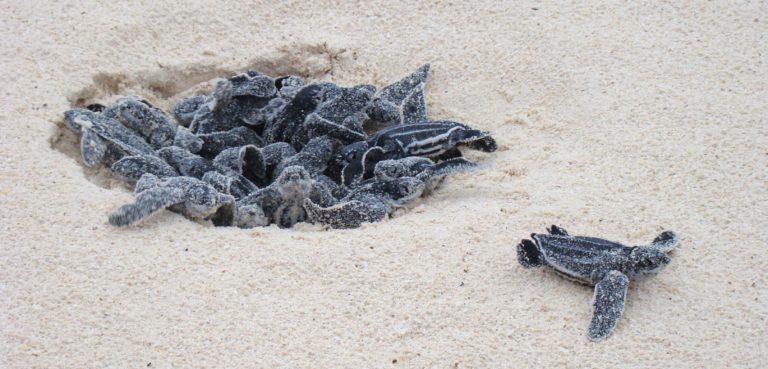
After the incubation period of about two months concludes, the hatchlings all crawl out of their nest at the same time, which is commonly referred to as a turtle boil. The hatchling will break free of its shell using an egg tooth called a caruncle. Once one hatchling breaks free of its shell in the egg chamber, this stimulates the other baby turtles to break free. By climbing on top of the broken shells, the turtles work together to dig out of the nest and stick together to maintain safety in numbers from predators as they make a break for the safety of the water.
Sadly, only about one in 1,000 sea turtles survive to adulthood. Two main obstacles for hatchlings are the predation of birds, crabs, and dune animals as well as dehydration that occurs if the turtle’s trek to the ocean is too slow.
While these outcomes simply are part of the circle of life, threats to nesting and sea turtle survival also are a direct result of humans. Coastal armoring, including sea bags and seawalls built to protect erosion of beachfront property, prevents female sea turtles from using ideal nesting grounds. Additionally, human trash and leftovers on beaches attract predators such as raccoons, foxes, and coyotes that dig up eggs for food. Another huge issue is the presence of artificial lighting at night, as it can disturb nesting females and prevent hatchlings from reaching the ocean.
What can you do to help the Sea Turtle population during this very important time?
Hatchlings emerging from the nest are capable of climbing out of the sand on their own and do not require assistance. Please do not dig into sea turtle nests – this could be considered a violation of state and federal laws!
Hatchlings that are making their way to the ocean on their own are best left to do so on their own. Please do not interrupt their crawl unless they are crawling away from the ocean.
Leave only footprints on the beach (pick up after yourself & others)
Manage light on your property (including docks) to make sure hatchlings & nesting females aren’t led astray. To manage light on your beachfront property you should: use sea turtle friendly lighting. You can also help by closing drapes and blinds, and shield or turn off outdoor lights that are visible on the beach.
- Recycle your fishing line
- Fill in holes dug along the beach
- Bring in beach furniture at night
- Support local turtle conservation groups, etc.
Report a sighting of a sick/injured sea turtle to FWC @ 888-404-FWCC (3922) or Marathon’s Turtle Hospital 305-743-2552
Loading Comments